
How to count macros (without losing your mind)
Stop typing meals into a database. Snap a photo and Joules logs it — calories, macros, and a health score, in one tap.
Get Joules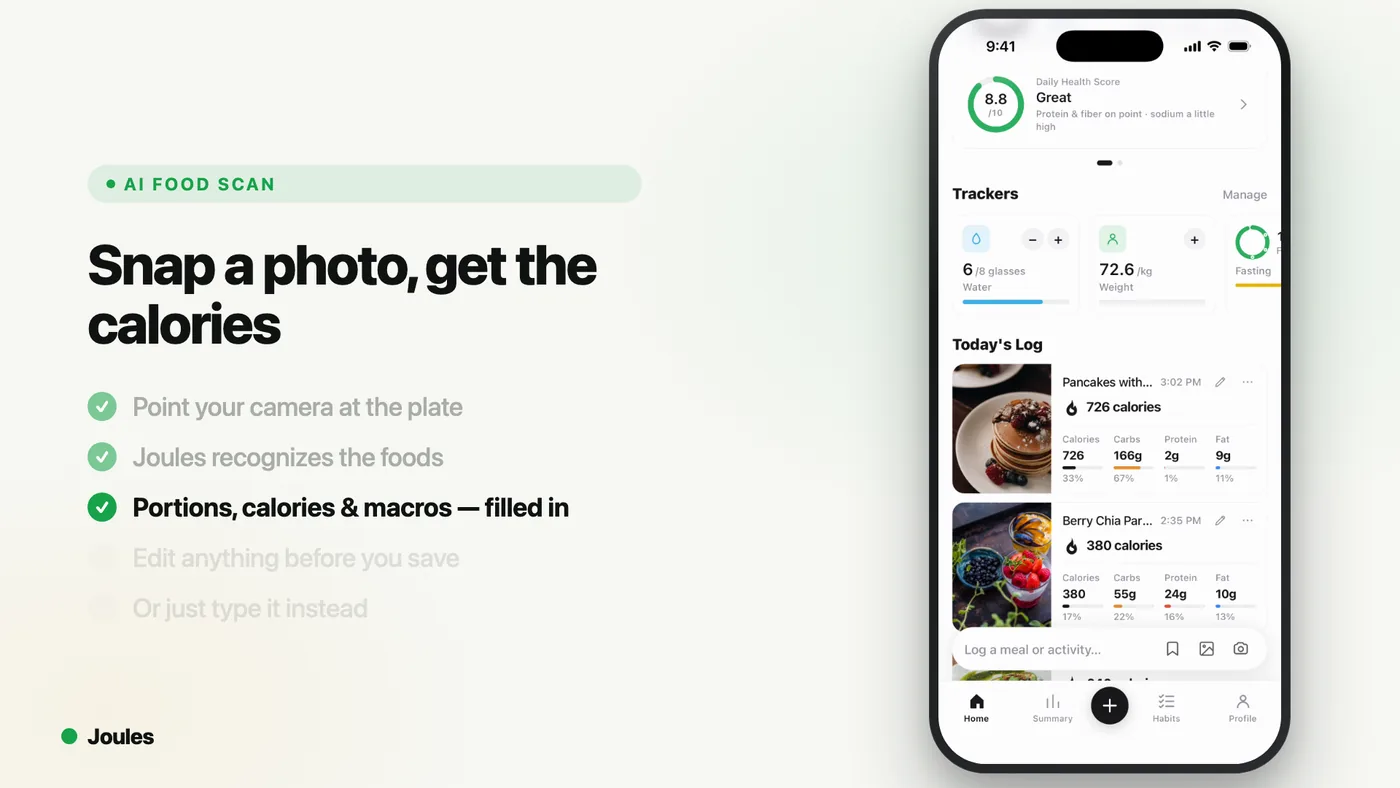
Somewhere along the way, counting macros picked up a reputation as a personality flaw. The food scale in the gym bag. The app you have to open before you're allowed to eat. I understand why people picture it that way, and I want to talk you out of it. The maths underneath is short and boring, and once you see what you're actually counting, you get to decide how tight or how loose to hold it. Your goal sets that dial, not some stranger on the internet.
What macros are
Macronutrients are the three things your body needs in bulk: protein, carbohydrate and fat. Each one carries a fixed amount of energy per gram, and the numbers are worth committing to memory because everything else hangs off them. Protein, 4 calories a gram. Carbohydrate, 4. Fat, 9, which is why a tablespoon of olive oil quietly outweighs a thick slice of bread. Those are the Atwater factors, worked out in the 1890s and still sitting behind every label you will ever read. Alcohol is the odd one out at 7 calories a gram, and no, no calculator is going to hand you a nightly wine target.
Count the grams, multiply, add it up. That's the whole thing. A day with 150 g of protein, 200 g of carbs and 70 g of fat runs 150 × 4 + 200 × 4 + 70 × 9, which comes to 2,030 calories. That's the entire engine. Everything after this is bookkeeping, and bookkeeping is where people quietly talk themselves into quitting.
Set calories first, then split them
Macro targets hang off a calorie number, so that number goes first. Your total daily energy expenditure, or TDEE, is what you burn on an ordinary day, and our TDEE calculator spits out an estimate in about a minute. Eat near it and your weight holds. Eat under to lose, over to gain. None of the split matters until this number is set.
Then you carve it up. Protein gets fixed first, at 1.6 to 2.2 g per kilogram of body weight. That is the range sports nutrition research keeps circling back to for people who actually train, and an 80 kg person lands somewhere between 128 and 176 g. Fat usually takes 20 to 35 percent of your calories. Carbohydrate gets whatever is left, and that is not a consolation prize.
Our macro calculator does this arithmetic and lets you slide the carb-to-fat balance toward the food you actually enjoy. A runner who lives on rice needs a different split than someone happiest with eggs and butter, and neither of them is doing it wrong. Total calories and protein carry almost the entire result. The rest is just preference, so stop agonising over it.
Reading labels without getting caught out
Labels are accurate and sneaky at the same time. Four traps cause most of the logging mistakes I see, and once you know them you stop falling for them.
- Serving sizes run small. A 90 g bag of crisps labelled as 2.5 servings is, in practice, one serving. Multiply before you log.
- Per 100 g is not per portion. Most labels show both columns. Log the one that matches what you ate.
- Zero does not mean zero. In the US, anything under 5 calories per serving can be rounded down to 0. Cooking spray claims nothing; a long spray is closer to 30 calories.
- Raw and cooked weights differ. Rice roughly triples in weight when boiled, so 100 g of dry rice and 100 g of cooked rice sit about 230 calories apart. Packet labels almost always describe the dry weight.
Pick the laziest method you can trust
Hand estimates are the lazy entry point, and I mean that as a compliment. A palm of protein, a cupped hand of carbs, a thumb of fat per meal gets you within range of a real plan. Crude? Completely. Still miles better than the nothing most people do.
Logging apps are the default. A barcode scanner and a food database do the arithmetic, and the output is exactly as good as your patience. That is the catch. Punching in a seven-ingredient stir-fry can eat 4 minutes, and the people who quit tracking almost always quit right there, mid stir-fry, thumbs tired.
Photo logging is the option that skips the typing. Joules reads the calories and macros straight from a picture of your plate and fills in the macro rings for you, so that 4-minute stir-fry becomes a 10-second photo. Whatever method you land on, consistency beats precision every time. A messy habit you keep at 80 percent accuracy will teach you more than a flawless system you have abandoned by Thursday.
A worked example day
Targets for the day: 2,000 calories, 150 g protein, 200 g carbs, 67 g fat. Here is one perfectly ordinary way the food gets you there, using label values and cooked weights.
- Breakfast. 300 g of 5% Greek yogurt, 60 g of oats and 100 g of blueberries. About 35 g protein, 61 g carbs, 20 g fat, 570 calories.
- Lunch. A wrap with 150 g of cooked chicken breast, one large tortilla, salad and a teaspoon of oil in the dressing. About 52 g protein, 38 g carbs, 15 g fat, 495 calories.
- Snack. An apple and 30 g of almonds. About 6 g protein, 31 g carbs, 15 g fat, 280 calories.
- Dinner. 150 g of salmon, 180 g of cooked basmati rice and 200 g of broccoli. About 41 g protein, 63 g carbs, 21 g fat, 605 calories.
Add it up and you land at 134 g protein, 193 g carbs and 71 g fat, roughly 1,950 calories. Protein is sitting 16 g short, and that is the gap worth closing. A 30 g scoop of whey in water adds 24 g of protein for about 120 calories, which finishes the day at 158 g and around 2,070. The 70-calorie overshoot? Noise. Ignore it. Notice what made this day easy to total up: single-ingredient foods, cooked weights, one deliberate protein source per meal. That is the trick, not the spreadsheet.
Mistakes that quietly wreck the numbers
- Tracking Monday to Friday only. Five careful days at 500 calories under maintenance are undone by two weekend days at 1,250 over. The week nets out at zero and the scale looks broken.
- Ignoring cooking fat. A tablespoon of oil is around 119 calories whether or not you can see it on the plate.
- Chasing exact targets. Finishing on 148 g of protein instead of 150 changes nothing. Weekly averages decide the outcome.
- Borrowing someone else's numbers. Targets scale with body weight and activity, so a 60 kg office worker and a 90 kg builder should not eat the same plan.
Common questions
Do I have to hit my macros exactly?
No. Within 5 to 10 g of each target is a hit, full stop. Your body responds to the week, not to Tuesday, so a day that runs high on fat and short on carbs sorts itself out by Friday. Chasing the exact gram is how people burn out on something that was meant to be simple.
Where does alcohol fit?
Alcohol carries 7 calories a gram and belongs in your total even though it never gets a target of its own. The usual fudge is to log a drink as carbs or fat: a 150-calorie beer becomes about 37 g of carbs, or 17 g of fat, on paper. Not elegant. It keeps the ledger honest, which is the point.
Is 40/30/30 a good split?
It is a fine place to start and nothing to get attached to. Percentage splits scale badly. 30 percent protein of a 1,400-calorie diet is 105 g; the same 30 percent at 2,800 calories is 210 g, which is more than almost anyone needs and a genuine chore to eat. Gram targets pinned to body weight, protein above all, hold up far better across calorie levels.
The short version
Estimate your TDEE. Fix protein at 1.6 to 2.2 g per kilogram. Hand fat 20 to 35 percent of your calories and let carbs fill the rest. Learn the four label traps once, then log with the least annoying method you will actually stick to. Nobody has ever been handed a medal for a decimal place.
Why people switch to Joules
- ✓AI reads your plate from a photo and fills in calories and macros
- ✓Numbers sourced from USDA FoodData Central, not crowd-sourced guesses
- ✓You confirm every entry before it saves — nothing is logged blind
- ✓Barcode scanning included, free
- ✓Barcode scanning is free — not locked behind a subscription
- ✓No ads, ever
- ✓No coaching upsell to reach your daily number
- ✓Calorie and macro logging with a daily health score that explains itself
- ✓Intermittent fasting timer and weight tracking built in
- ✓Habit tracking with custom trackers and a consistency grid per habit
Snap a photo, confirm, done — logging a meal takes about a second.
Get JoulesTypical calorie needs for adult women and men, the formula behind the estimates, and how to set a daily target for losing, maintaining or gaining weight.
A calorie deficit means eating less energy than you burn. How the 7,700-calorie kilogram works, sensible weekly rates, and why bigger cuts backfire.