
How many calories should you eat a day?
Stop typing meals into a database. Snap a photo and Joules logs it — calories, macros, and a health score, in one tap.
Get Joules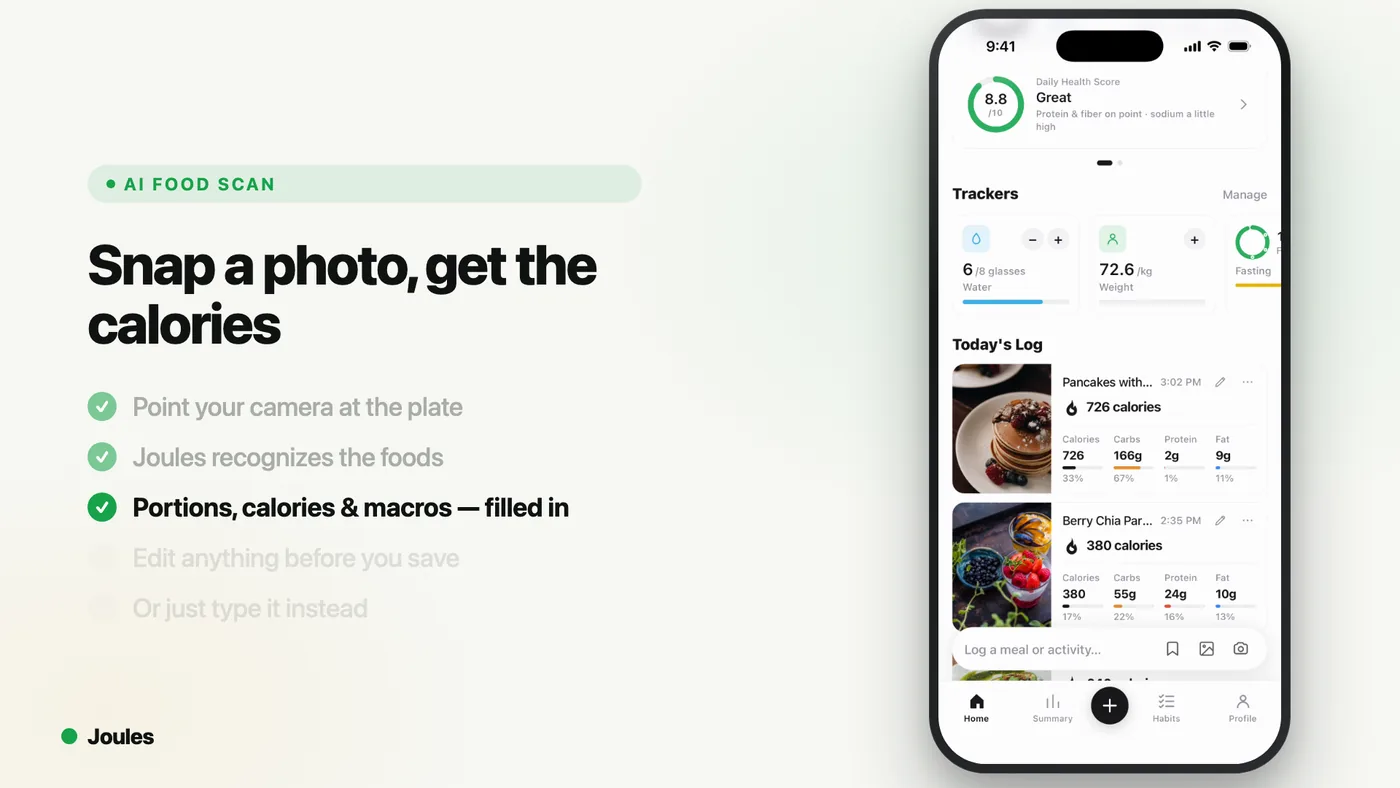
Every food label says about 2,000 a day. For a decent slice of adults that's not a terrible guess, and for everyone else it's off by up to 1,000 calories in one direction or the other. Picture a 58 kg woman at a desk and a 95 kg man laying bricks walking past the same label. Their real needs can sit 1,500 calories apart, and the label just shrugs. The number that helps you is your own, not the printed one. Here's how to find it, and the honest ranges to expect on the way.
Why there is no single number
Everything you burn in a day adds up to your total daily energy expenditure, or TDEE. The biggest chunk, usually 60 to 70 percent, is basal metabolism: the rent your body pays to keep your organs running while you do absolutely nothing. Digestion takes another 10 percent or so. Movement covers the rest, from a hard workout down to the walk to the kettle.
Body size shifts the total more than anything else. Age, sex and muscle move it further; activity swings it hardest of all. Two honest examples. A 30-year-old woman, 165 cm and 62 kg, desk job, two gym visits a week, lands near 1,900 calories a day. A 35-year-old man, 183 cm and 88 kg, on his feet all day, lands near 2,900. Our TDEE calculator estimates yours from the same inputs in about a minute. Expect it to be within roughly 10 percent. It is a starting line, not a verdict.
Typical adult ranges, honestly
For context, the Dietary Guidelines for Americans put most adult women between 1,600 and 2,400 calories a day, and most adult men between 2,000 and 3,000. The floor of each range is the small, sedentary end; the ceiling is the large or very active end. These are population averages, painted with a wide brush. That 2,000 on the label exists so the percentages have something to point at. Nobody picked it with your body in mind. Use it to sanity-check your own estimate, not to set it.
Where the estimate comes from
Most calculators, ours included, run on the Mifflin-St Jeor equation, published in 1990 and still the default for estimating resting metabolism. For men it is 10 × weight in kg + 6.25 × height in cm − 5 × age + 5. For women, that last number flips to −161. Multiply the result by an activity factor, somewhere between 1.2 for sedentary and 1.9 for hard daily training, and out comes your TDEE. Our calorie calculator runs the whole thing and lays maintenance, loss and gain targets side by side, so you can see the trade in one look.
Adjusting for a goal
Eat at your TDEE and your weight sits still, which is a real goal, not a failure to have one. To lose, eat under it. A gap of 300 to 500 calories a day is what most people can hold without white-knuckling every meal, and it buys roughly 0.3 to 0.5 kg a week. Our calorie deficit calculator turns your TDEE into a daily target for whatever rate you pick. Judge it on the weekly average, never a single grumpy morning on the scale.
To gain, run it backwards. A surplus of 200 to 300 calories a day paired with resistance training feeds slow muscle growth. A much larger surplus mostly just fills the fat stores faster, so more is not better here. A slice of toast with peanut butter gets you most of the way to a 300-calorie surplus, which shows how little it actually takes.
How low is too low
Lower is not a shortcut, and I would gently push back on anyone selling it as one. Under about 1,200 calories a day for women, or 1,500 for men, it gets genuinely hard to cover protein, iron, calcium and the rest from ordinary food, which is why dietitians treat those numbers as floors for dieting without supervision. Very low targets also tend to detonate in practice: hunger stacks up for a fortnight, then one weekend erases the whole ledger. Go under the floor and energy, mood and training are usually the first things to suffer, and more of the weight you do lose comes off as muscle. If a calculator hands you a number below the floor, eat at the floor and take the slower road.
When a calculator is the wrong tool
Formulas assume a healthy adult living an ordinary life. If you're pregnant or breastfeeding, under 18, recovering from disordered eating, or managing something like diabetes or thyroid disease, your calorie target belongs in a conversation with a doctor or a registered dietitian, not a text box. Same goes if a medication is pulling on your appetite or weight. None of this is medical advice, and I'd rather say that plainly than bury it at the bottom.
A sensible way to start
Estimate your TDEE, eat near it for 2 or 3 weeks, and watch the weekly average on the scale. If the trend and your goal disagree, nudge by 100 to 200 calories, which is about one snack in either direction, and give it another fortnight. This is where logging earns its place, and it is the part most people find a slog. Joules keeps it light: photograph a meal and it estimates the calories, then folds the day into a single health score that tells you, in plain words, why it landed where it did. Your body keeps the real books either way. The formulas just get you to the right chapter.
Why people switch to Joules
- ✓AI reads your plate from a photo and fills in calories and macros
- ✓Numbers sourced from USDA FoodData Central, not crowd-sourced guesses
- ✓You confirm every entry before it saves — nothing is logged blind
- ✓Barcode scanning included, free
- ✓Barcode scanning is free — not locked behind a subscription
- ✓No ads, ever
- ✓No coaching upsell to reach your daily number
- ✓Calorie and macro logging with a daily health score that explains itself
- ✓Intermittent fasting timer and weight tracking built in
- ✓Habit tracking with custom trackers and a consistency grid per habit
Snap a photo, confirm, done — logging a meal takes about a second.
Get JoulesWhat macros are, how to set protein, carb and fat targets, and how to read labels without being fooled. A plain-English guide to counting macros.
A calorie deficit means eating less energy than you burn. How the 7,700-calorie kilogram works, sensible weekly rates, and why bigger cuts backfire.