
Do calorie counting apps actually work?
Stop typing meals into a database. Snap a photo and Joules logs it — calories, macros, and a health score, in one tap.
Get Joules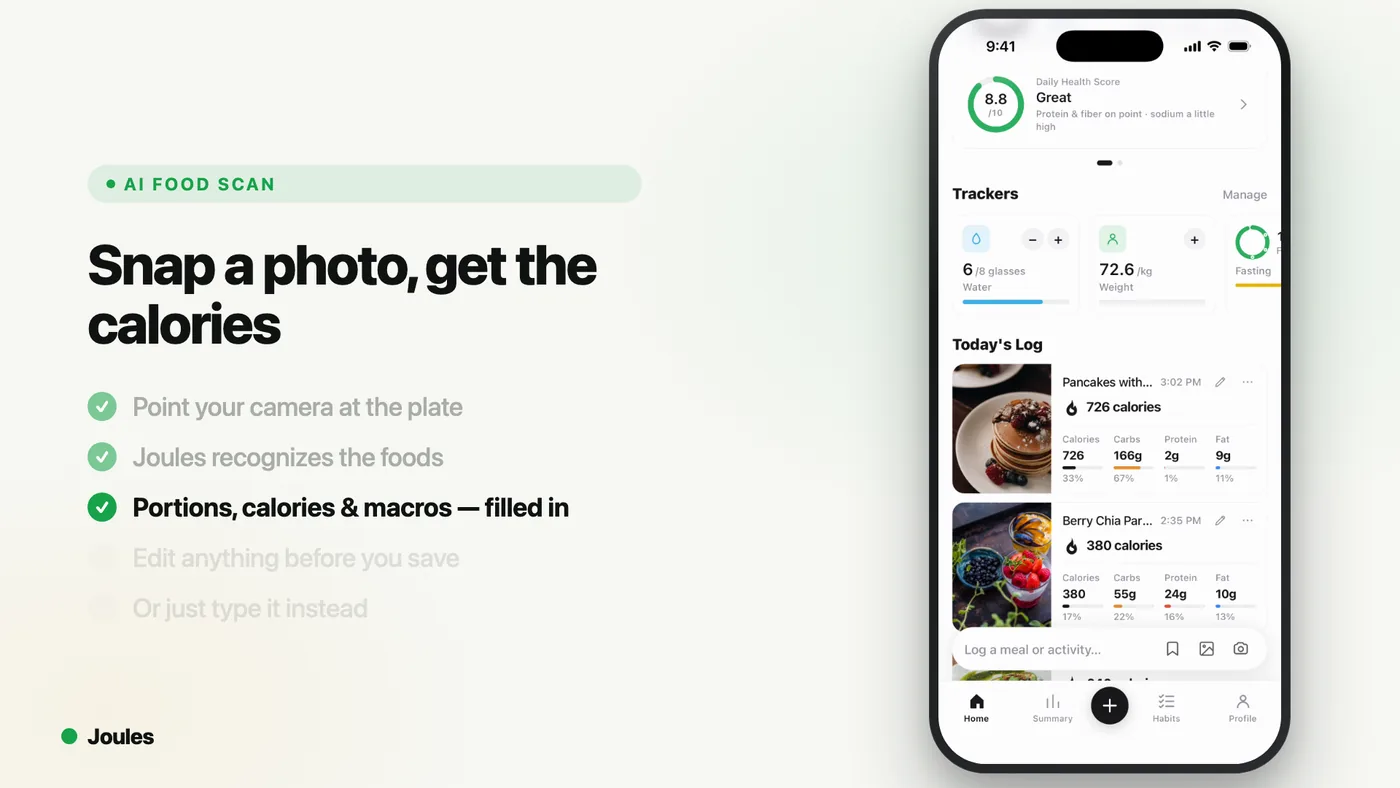
The question is really two questions wearing one coat. Does tracking your food change anything, and are the numbers in these apps actually right? The answers are yes and not really, in that order, and the genuinely interesting bit is that the second one does not sink the first.
What the research suggests
Dietary self-monitoring, which just means writing down what you eat in some form, is one of the steadiest correlates of success in behavioural weight-loss research: in structured programmes, people who log regularly tend to lose more than people who log rarely. The honest caveat is that the arrow points both ways, because people who are already doing well find it easier to keep logging. Even after you discount for that, the evidence leans the same direction, and it lines up with something you can feel in your own week. A log replaces memory, and memory flatters. Ask someone to recall a day of eating and they'll miss the snacks, the cooking oil, the two beers, and the misses all run the same direction. Downward.
An app is just the cheapest way to run that habit. The database and barcode scanner kill the arithmetic; the history kills the wishful thinking.
Where the numbers go wrong
- Labels are legally approximate. US rules allow stated calories to be off by up to 20 percent, so a 200-calorie label can lawfully describe a 240-calorie serving.
- Restaurant portions drift. The plate in front of you is not the plate that was tested, and a generous hand with oil adds 100 calories without malice.
- Portions get estimated. A freehand tablespoon of peanut butter is often two, which turns 95 calories into 190. Databases are precise about servings nobody measures.
- User-submitted entries carry errors. Popular foods often exist five times in a database with five different counts. Prefer verified entries where they exist.
- Exercise calories run hot. Watches and cardio machines commonly overstate burn, and eating those calories back erases real deficits.
Stack all that up and a careful day of logging can sit 10 to 30 percent off the truth. Which sounds fatal to the whole enterprise. It is not, for one reason.
Why they work anyway
You almost never need the true number. You need a consistent one. The weigh-in is the real measurement; the log is just the dial you turn against it. If your app says 1,900 a day and the scale trend says maintenance, then your true intake sits near your true maintenance whatever the absolute error, and cutting the logged number to 1,600 opens a real deficit. A bathroom scale that reads 2 kg heavy still tells you honestly whether the line is heading down. The adjustment method is spelled out in our calorie deficit guide, the target-setting half in how many calories should you eat a day, and the TDEE calculator provides the starting estimate that the scale then corrects.
Consistency beating precision is the running theme of our macro counting guide: sixty logged days with a stable bias beat six flawless ones.
The loop takes about two weeks to bed in. Log normally, weigh most mornings, compare weekly averages. If the log says 1,900 a day and your weight held steady, call 1,900 your working maintenance and set every target from there. After that the app only has to stay consistent with itself, which is a far lower bar than being right.
When tracking is the wrong tool
Burnout is the common way it fails. Entering a seven-ingredient dinner one ingredient at a time takes minutes every single night, and most people quietly stop within a few weeks. An abandoned tracker helps nobody, and I'd call that a design problem before a willpower one.
The sharper problem is rarer, and it's serious. For some people the numbers stop being information and turn into rules: a jolt of anxiety when a meal can't be logged, a shrinking list of 'allowed' foods, exercise done as penance for eating. If you have any history of an eating disorder, calorie apps are generally a bad idea, and plenty of apps say exactly that in their own fine print. If any of that lands close to home, please skip the apps and talk to your doctor or an eating disorder professional instead. Tracking is a tool for energy budgets. It has nothing useful to say to real distress, and it can make it worse.
If you want awareness without the grams, you have options: hand-portion estimates and a plain photo diary with no numbers both keep some feedback in the loop at a fraction of the effort.
Where photo logging fits
Most of the friction lives in data entry, not arithmetic, and that is the part photo logging goes after. Joules, the app this site comes from, works straight from a picture of your plate: the camera does the recognising, and an estimate lands in seconds instead of minutes. It also rolls the day into a single health score that tells you why it landed where it did, which is more useful than a bare number. Photo estimates are still estimates, and the case for them is adherence, plain and simple: the log you actually keep beats the flawless log you gave up on in week two.
So the verdict reads like a household budget. The numbers are imperfect, the act of looking changes your behaviour, and the trend quietly corrects the errors. Use an app for a defined purpose, expect noise in any single entry, adjust from the scale rather than the app, and stop the moment the counting starts running you instead of the other way round.
Common questions
How accurate are calorie counting apps?
Individual entries are commonly off by 10 to 30 percent once label tolerance, portion guesses and database errors pile up. Weekly averages are far steadier, because the same errors repeat in the same direction. Treat a single day as weather and the month as climate.
Do I have to track forever?
No, and most people shouldn't. A few weeks of honest logging calibrates your eye for portions, and that's the durable skill worth having. The common pattern is tracking in blocks: a few weeks at the start, again when progress stalls, and through deliberate phases like a cut or a gain. Between blocks, the bathroom scale keeps score.
Do I need to weigh my food?
For a few calibration weeks, a cheap kitchen scale is the fastest way to learn what 30 g of oats or an actual tablespoon of peanut butter looks like, and the lesson sticks. After that, keep weighing only where guesses hurt most, which in practice means oils, nut butters, cheese and rice. Everything else survives a good estimate.
Why people switch to Joules
- ✓AI reads your plate from a photo and fills in calories and macros
- ✓Numbers sourced from USDA FoodData Central, not crowd-sourced guesses
- ✓You confirm every entry before it saves — nothing is logged blind
- ✓Barcode scanning included, free
- ✓Barcode scanning is free — not locked behind a subscription
- ✓No ads, ever
- ✓No coaching upsell to reach your daily number
- ✓Calorie and macro logging with a daily health score that explains itself
- ✓Intermittent fasting timer and weight tracking built in
- ✓Habit tracking with custom trackers and a consistency grid per habit
Snap a photo, confirm, done — logging a meal takes about a second.
Get JoulesWhat macros are, how to set protein, carb and fat targets, and how to read labels without being fooled. A plain-English guide to counting macros.
A calorie deficit means eating less energy than you burn. How the 7,700-calorie kilogram works, sensible weekly rates, and why bigger cuts backfire.
Typical calorie needs for adult women and men, the formula behind the estimates, and how to set a daily target for losing, maintaining or gaining weight.