
How to gain weight: the arithmetic and the eating
Stop typing meals into a database. Snap a photo and Joules logs it — calories, macros, and a health score, in one tap.
Get Joules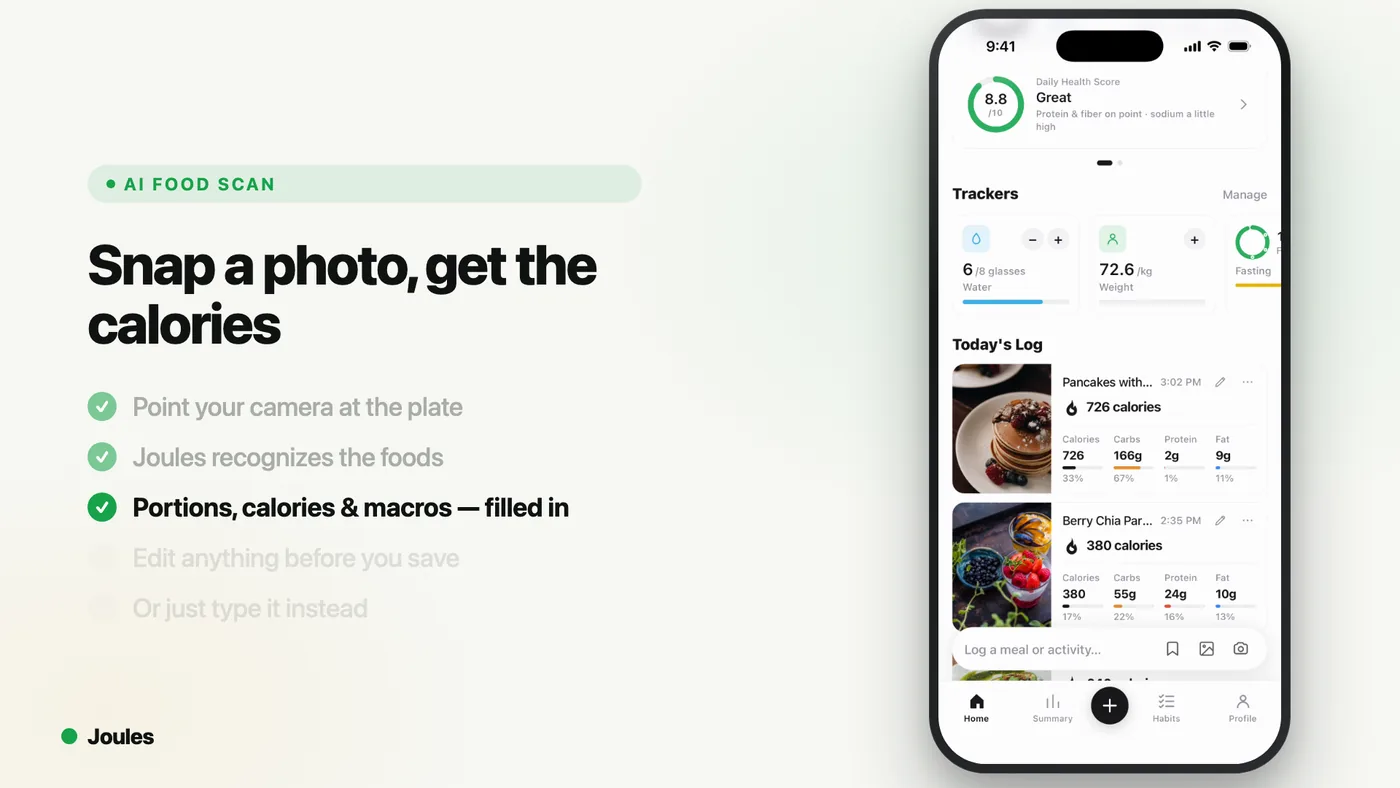
Almost everything written about calories assumes you want fewer of them. Gaining weight runs the exact same ledger in reverse, and if you're the kind of person who ate everything in sight all week and somehow lost 200 g, you already know it can be the harder direction. The method itself is not a mystery. Eat more than you burn, keep protein high, lift, and hold the line for months. The hard part is the months.
Start with the surplus
Your total daily energy expenditure, or TDEE, is what you burn on an ordinary day, and our TDEE calculator estimates it from height, weight, age and activity. Gaining means eating above that number, full stop. A surplus of 300 to 500 calories a day is the range I'd start with: on paper it buys about 0.3 to 0.5 kg a week, and in practice it's small enough to hit without force-feeding yourself at 10pm.
Set our calorie calculator to weight-gain mode and it hands you the daily target. Then run the loop: weigh a few mornings a week, average each week, and judge by the trend, not by yesterday. If the average stays flat for two or three weeks, add 200 calories and give that target the same trial. If maintenance itself is still a mystery, how many calories should you eat a day walks through the honest ranges first.
Protein still leads
The surplus decides that you gain. Protein and training decide what you gain. The standard range applies here too, 1.6 to 2.2 g per kilogram a day, so 112 to 154 g for a 70 kg person, and our protein calculator produces your number. There is no prize for doubling it. Protein is also the most filling macronutrient per calorie, which is a genuine nuisance in a gain phase. Hit the target and stop. The rest of the calories belong to carbs and fat, split however you actually like to eat.
Calorie-dense foods that do the heavy lifting
Failed gain phases almost always come down to volume: your stomach fills before your target does. The fix is food that carries more calories per bite, so you are not chewing all day.
- Olive oil. 119 calories per tablespoon, invisible in a pan or over rice.
- Peanut butter. 190 calories and 8 g of protein in 2 tablespoons.
- Whole milk. 150 calories per 250 ml glass, with 8 g of protein. Swap it in wherever water was the default.
- Nuts. 170 to 200 calories per 30 g handful.
- Granola. 230 calories per 50 g, before the milk arrives.
- Dried fruit. 85 calories per 30 g of raisins; 4 medjool dates come to about 265.
- White rice. About 260 calories per 200 g cooked, and easy to eat past fullness.
- Avocado. Around 240 calories each.
- Cheese. 115 calories per 28 g, and it improves everything it lands on.
- Bagels. About 250 calories plain, where a slice of bread runs 80.
The single most useful thing in your kitchen is a blender. 300 ml of whole milk, 60 g of oats, a banana, 2 tablespoons of peanut butter and a 30 g scoop of whey comes to about 820 calories and 50 g of protein, drinkable in five minutes with zero chewing fatigue. One of those a day closes most of the gap on its own.
Tactics for people who fill up fast
- Eat by the clock. Appetite is a terrible accountant in a gain phase. Three meals and two or three snacks at set times beats sitting around waiting for a hunger that never turns up.
- Drink some of your calories. Milk, smoothies and juice slip past the fullness that solid food triggers.
- Start meals with the dense food. Rice, meat and bread before salad, soup or anything described as light.
- Keep portable food in reach. Our high-protein snacks list covers the protein side; add a handful of nuts to any of them and the calories follow.
- Log two honest weeks. People who 'can't gain' almost always overestimate what they eat. The record usually shows two big days and five ordinary ones. Photograph your meals in Joules for a fortnight and let the macro rings settle the argument. It is rarely the story people expect.
Lift, or the surplus goes to storage
A surplus without training mostly turns into fat. Resistance training two to four times a week, with loads or reps that creep up over time, is what points the extra energy at muscle. The principle is called progressive overload, and it matters more than any supplement you'll ever agonise over. Muscle comes slowly even when everything goes right, at a pace measured in hundreds of grams a month, not kilograms. That's exactly why the sensible rate of scale gain is modest, around 0.25 to 0.5 percent of body weight a week, roughly 1 to 2 kg a month for most people. Gain faster than that and the extra is mostly fat you'll pay to remove later.
When to involve a professional
Unintentional weight loss, regaining after an illness, a history of disordered eating, or trying to gain as a teenager are all situations for a doctor or registered dietitian, not a calculator and a blog post. Same goes if a genuinely logged surplus produces nothing over six or more weeks. That deserves a medical conversation, not another 500 calories. Nothing here is medical advice.
Common questions
Can I just dirty bulk?
You can, and the scale will reward you fast. The mirror won't. Past a moderate surplus, extra calories add fat quicker than muscle, and the months you save now get spent dieting them off later. A 300 to 500 calorie surplus is dull and it works. Dull and works is the whole game.
Do mass gainers work?
They're calories in powder form, often 1,000-plus a serving, mostly maltodextrin. They work the same way the blender smoothie above works, at several times the price. Buy one if convenience is your real constraint. The physics doesn't care which you pick.
Why people switch to Joules
- ✓AI reads your plate from a photo and fills in calories and macros
- ✓Numbers sourced from USDA FoodData Central, not crowd-sourced guesses
- ✓You confirm every entry before it saves — nothing is logged blind
- ✓Barcode scanning included, free
- ✓Barcode scanning is free — not locked behind a subscription
- ✓No ads, ever
- ✓No coaching upsell to reach your daily number
- ✓Calorie and macro logging with a daily health score that explains itself
- ✓Intermittent fasting timer and weight tracking built in
- ✓Habit tracking with custom trackers and a consistency grid per habit
Snap a photo, confirm, done — logging a meal takes about a second.
Get Joules28 high-protein snacks with protein grams and calories for each: grab-and-go, fridge, sweet and salty picks, plus the cutoff we used to choose them.
Typical calorie needs for adult women and men, the formula behind the estimates, and how to set a daily target for losing, maintaining or gaining weight.
What macros are, how to set protein, carb and fat targets, and how to read labels without being fooled. A plain-English guide to counting macros.