Joules app iconJoules

RMR Calculator

Estimate your resting metabolic rate, the calories your body burns at rest, from your height, weight, age, and sex, then see how it relates to BMR and your full daily burn.

Unidades
Sexo

Body fat % is optional. Add it and the estimate switches to Katch-McArdle, which works from your lean mass.

Your resting metabolic rate (RMR)
1,738kcal/day

The energy your body burns at rest, estimated with the Mifflin-St Jeor equation

1,738 kcal
Mifflin-St Jeor
1,804 kcal
Harris-Benedict

RMR and BMR describe the same thing, the energy you burn at rest. BMR is measured after an overnight fast in a fully rested state, while RMR is taken under slightly looser conditions and reads a few percent higher. These equations estimate both. Multiply your RMR by an activity factor to get the calories you burn across a whole day, which is what the TDEE calculator does.

Your RMR is a starting estimate. Log a couple of weeks of meals and weight in Joules, and it settles on the resting number your body actually holds.

Descarga Joules

What RMR measures

Resting metabolic rate (RMR) is the energy your body spends doing nothing at all. Fully at rest it still keeps your heart beating, your lungs moving, your temperature steady, and your cells repairing, and that work has a calorie cost. For most people RMR is the largest slice of daily energy use, usually 60 to 75 percent of the total.

Because it is so large, RMR is the natural starting point for a calorie plan. Once you know roughly how much you burn at rest, adding your activity on top gives your full daily burn, and that figure is what you eat around to hold, lose, or gain weight.

RMR versus BMR

RMR and basal metabolic rate (BMR) often get used interchangeably, and for planning they are close enough to treat as one number. The gap is in measurement. A true BMR is taken in a lab after an overnight fast, first thing in the morning, following overnight rest. RMR is measured under gentler conditions, without that strict protocol, so a measured RMR usually reads a few percent above a measured BMR.

The prediction equations here do not know which conditions you will sit under, so they return a single estimate that stands in for both. If you have already used the BMR calculator, you will see the same figure here from the same inputs. The label differs; the math does not.

How this calculator works

The headline number comes from the Mifflin-St Jeor equation, the most reliable predictor for the general population (Mifflin MD, St Jeor ST et al., 1990):

For comparison the calculator also shows the revised Harris-Benedict estimate (Harris JA, Benedict FG, 1918; Roza and Shizgal revision, 1984), which tends to read a little higher. If you enter a body fat percentage, the estimate switches to the Katch-McArdle equation, which predicts resting calories from lean body mass rather than total weight, so it fits lean and muscular people better.

What changes your RMR

Two people at the same weight can have different resting rates. The main levers are:

A long calorie deficit also nudges RMR down as the body adapts to less food. Resistance training and enough protein are the practical ways to protect it.

From RMR to a daily calorie target

RMR on its own is not what you eat. It is the resting floor. To reach your total daily energy expenditure, multiply RMR by an activity factor, from about 1.2 for a mostly seated day up to 1.9 for hard daily training. The TDEE calculator applies that step and gives the number you burn on a normal day.

From there the goal sets the target. The maintenance calorie calculator shows the intake that holds your weight, and the calorie calculator sets a target for losing or gaining at a chosen rate. RMR is where all of those numbers begin. These are estimates, not medical advice; check with a doctor or dietitian before a large change.

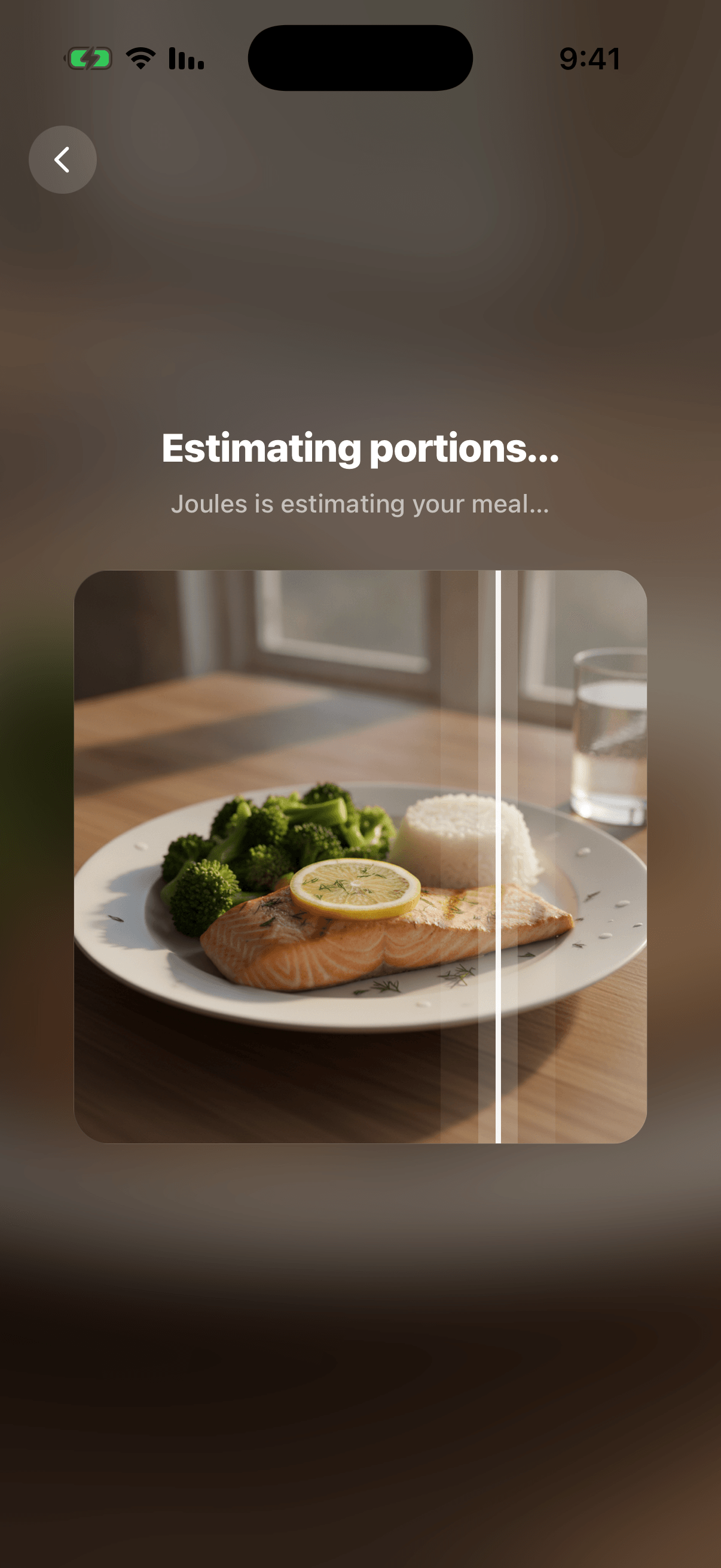
Joules AI food scan
El rastreador creado para ser el más preciso

Todo lo que hacen MyFitnessPal, Cal AI y Noom — en una sola app tranquila

Diseñado para la precisión
  • La IA lee tu plato desde una foto y completa las calorías y los macros
  • Cifras tomadas de USDA FoodData Central, no de conjeturas de usuarios
Sin juegos de muro de pago
  • El escaneo de códigos de barras es gratis — no está bloqueado tras una suscripción
  • Sin anuncios, nunca
Una sola app tranquila, no tres
  • Registro de calorías y macros con una puntuación de salud diaria que se explica sola
  • Temporizador de ayuno intermitente y seguimiento del peso integrados

Preguntas frecuentes

What is RMR?

RMR, or resting metabolic rate, is the calories your body burns at rest to keep basic functions like breathing, circulation, and cell repair running. For most people it makes up roughly 60 to 75 percent of the calories burned in a day.

What is the difference between RMR and BMR?

They measure the same thing: energy burned at rest. The difference is how they are measured. BMR is taken after an overnight fast, first thing in the morning, fully rested. RMR is measured under looser conditions, so a real RMR reading runs a few percent higher than a real BMR reading. The equations here estimate both from the same inputs, so the number works as either.

How is RMR calculated?

This calculator uses the Mifflin-St Jeor equation by default, which predicts resting calories from your weight, height, age, and sex. It also shows the Harris-Benedict estimate for comparison. If you enter a body fat percentage, it switches to the Katch-McArdle equation, which works from your lean mass.

How accurate is an RMR estimate?

A prediction equation lands within about 10 percent of a lab measurement for most people. Muscle mass, past dieting, and thyroid function all move the real number, so treat the estimate as a starting point and adjust it against how your weight actually changes over a few weeks.

How do I turn RMR into daily calories?

Multiply your RMR by an activity factor, from about 1.2 for a mostly seated day up to 1.9 for hard daily training. The result is your total daily energy expenditure, or TDEE, the calories you burn on a normal day. The TDEE calculator does this step for you.

Can I use RMR to lose or gain weight?

Not on its own. RMR is only the resting portion. To lose or gain, first estimate your full daily burn, then eat below or above it. Use the maintenance calorie calculator to find the level that holds your weight, then the calorie calculator to set a loss or gain target.

Does RMR slow down with age or dieting?

Yes, modestly. RMR falls as you get older, mostly because people lose muscle, and it dips during a long calorie deficit as the body adapts. Keeping muscle through resistance training and enough protein is the main way to hold it up.

Calculadoras relacionadas

Una nota sobre la precisión: las calculadoras como esta dan estimaciones basadas en fórmulas poblacionales — tus necesidades reales varían según la genética, la masa muscular, las condiciones médicas y más. Los resultados son solo informativos y no constituyen consejo médico, diagnóstico ni prescripción. Habla con un médico o con un nutricionista certificado antes de hacer cambios importantes en tu dieta o ejercicio, sobre todo si tienes una condición de salud, estás embarazada o eres menor de 18 años.